road & bridgeroad & bridge
Scaling New Heights With Liebherr On Helsinki’S Landmark Kruunuvuori Bridge
By Highways Today - Road•05-24-2026May 24, 2026•8 min
Highways Today - Road•05-24-2026May 24, 2026•8 min road-bridge
The construction of major bridge infrastructure often captures attention through its scale, engineering ambition and long-term public value. Yet behind every landmark structure stands an equally complex network of construction technologies, specialist equipment and engineering expertise working quietly in the background. Finland’s new Kruunuvuori Bridge in Helsinki is a prime example. While the bridge’s striking 135-metre diamond-shaped pylon will become an iconic addition to the city skyline, delivering that structure safely and accurately required a tower crane capable of operating at the very limits of modern construction engineering.
Between the winter of 2022 and the completion of major structural works in 2025, a Liebherr 630 EC-H 40 Litronic tower crane played a pivotal role in constructing the bridge’s defining central pylon. Operating in one of Northern Europe’s most challenging construction environments, the crane handled critical lifting operations throughout the project, helping contractors maintain progress despite harsh winter weather, maritime wind exposure and the logistical complexities associated with building Finland’s tallest bridge structure.
The project demonstrates how modern tower crane technology has evolved beyond simple lifting equipment. Today’s large infrastructure schemes increasingly depend upon sophisticated engineering collaboration, advanced digital control systems and highly customised crane configurations capable of adapting to unique site conditions. As infrastructure projects become taller, larger and more technically demanding, crane engineering has become an essential component of project success rather than merely a supporting service.
Infrastructure projects are increasingly being designed with service lives measured not in decades but in centuries. The Kruunuvuori Bridge reflects this trend. Commissioned by the City of Helsinki and designed by WSP Finland together with Knight Architects, the cable-stayed structure spans approximately 1.2 kilometres across the Kruunuvuorenselkä Bay, linking Laajasalo, Korkeasaari and Kalasatama with Hakaniemi in central Helsinki.
What distinguishes the bridge from many recent transport projects is its emphasis on sustainable urban mobility. Rather than serving private vehicles, the crossing has been designed exclusively for trams, pedestrians and cyclists. This approach aligns closely with wider European transport policy objectives that encourage public transport use, reduce urban congestion and lower carbon emissions through modal shift.
The bridge forms a central element of Helsinki’s broader urban development plans, supporting future residential expansion in the Laajasalo district. City authorities anticipate that more than 20,000 residents will ultimately benefit from improved year-round transport links between the growing eastern districts and the city centre.
Its planned 200-year design life further illustrates the growing focus on infrastructure resilience. Across Europe, governments and infrastructure owners are increasingly seeking assets capable of withstanding future environmental, economic and demographic pressures while minimising lifecycle maintenance costs. Designing for two centuries requires rigorous attention to structural durability, material selection and construction quality from the earliest stages of delivery.
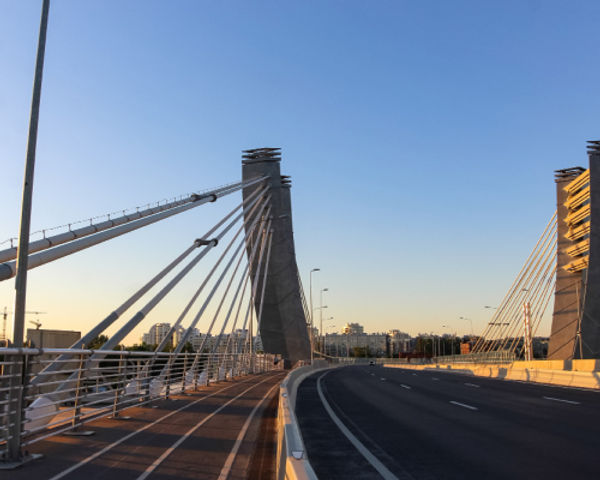
The bridge’s most visually striking feature is undoubtedly its central diamond-shaped pylon, which rises 135 metres above sea level. Constructing a reinforced concrete structure of this scale presented significant engineering challenges that extended well beyond conventional bridge construction practices.
Every stage of the pylon build required carefully coordinated lifting operations. Formwork systems had to be positioned with precision, reinforcement cages needed accurate placement at increasing heights, and concrete delivery equipment required regular relocation as construction advanced upwards. Structural components had to be transported safely and efficiently throughout the evolving geometry of the tower.
As elevation increased, so too did the complexity of crane operations. Wind exposure intensifies dramatically with height, and even relatively small movements can become significant when handling heavy loads hundreds of metres above ground level. Maintaining productivity while ensuring safety demanded equipment capable of delivering both lifting performance and exceptional operational precision.
For contractors, equipment reliability becomes particularly important under such circumstances. Unexpected downtime can have significant implications for project schedules, labour coordination and overall construction costs. Consequently, selecting equipment with proven performance characteristics becomes a strategic decision rather than a simple procurement exercise.
The Liebherr 630 EC-H 40 Litronic provided the performance envelope required to support construction throughout the pylon’s development. Featuring a maximum lifting capacity of 40 tonnes and a jib radius extending to 80 metres, the crane was capable of handling the diverse range of loads encountered during construction.
Its standard hook height capability of approximately 80 metres could be further extended through specialised configurations, enabling continued operation as the structure approached its final height. This flexibility proved particularly important as construction progressed through successive phases and lifting requirements evolved.
Modern tower cranes have become increasingly sophisticated pieces of engineering equipment. Advanced drive systems, precision control technologies and digital monitoring capabilities enable operators to manage complex lifts with greater accuracy than ever before. These capabilities become especially valuable on projects where millimetre-level positioning accuracy can influence both structural quality and construction efficiency.
Digital crane management systems have also transformed operational visibility. Contemporary control platforms provide detailed performance data, safety monitoring functions and diagnostic capabilities that help project teams maintain productivity while supporting preventative maintenance strategies.
While the crane itself represented a major technological asset, its successful deployment depended equally upon careful engineering of the tower configuration.
According to project information, specialists from Liebherr Tower Crane Solutions became involved during the early planning stages to develop a configuration capable of meeting the project’s unusual height requirements and complex tie-in arrangements.
As construction progressed, the relationship between the crane and the emerging pylon evolved continuously. Guying arrangements required modification, hook heights needed adjustment and structural loading conditions changed as the bridge structure developed. These adjustments demanded detailed engineering analysis to ensure safety margins remained fully maintained throughout the project lifecycle.
One member of the Tower Crane Solutions team explained: “Both the complex guying geometry and the regular adjustments to the guying and hook heights, driven by the progress of the construction works, required a high level of structural engineering expertise. By fully utilising the available structural capacity, we were able to apply our know-how to deliver a safe and efficient solution.”
Such specialist support increasingly characterises major infrastructure projects. Contractors frequently rely upon close collaboration between equipment manufacturers, structural engineers and project teams to optimise performance while maintaining rigorous safety standards.
The physical environment presented another layer of complexity. Unlike many urban bridge projects, the Kruunuvuori Bridge site sits across an exposed section of the Baltic Sea. With limited natural shelter, the location experiences wind conditions from multiple directions and remains vulnerable to rapidly changing weather patterns.
Winter conditions add further complications. Helsinki routinely experiences prolonged periods of sub-zero temperatures, creating challenges for mechanical systems, electrical components, hydraulic equipment and workforce operations. Maintaining equipment reliability in these conditions requires robust design, careful maintenance planning and effective operational procedures.
Wind loading represented a particularly significant engineering concern. As tower height increased, both static and dynamic wind forces acting upon the crane structure became increasingly important factors. Engineers had to account for these forces throughout the crane’s operational life while ensuring safe lifting performance remained achievable under varying environmental conditions.
Such challenges are becoming more relevant globally as infrastructure projects move into increasingly difficult environments, from offshore energy developments and Arctic facilities to mountainous transport corridors and coastal megaprojects.
The significance of the Kruunuvuori Bridge extends beyond Helsinki itself. Around the world, governments are investing heavily in infrastructure that supports sustainable mobility, urban growth and long-term economic resilience. According to the Organisation for Economic Co-operation and Development (OECD), infrastructure investment requirements continue to rise as cities expand and nations modernise ageing transport networks.
At the same time, public expectations regarding environmental performance, resilience and asset longevity are increasing. Infrastructure owners now expect projects to deliver social value, climate resilience and operational efficiency alongside traditional engineering performance.
The Kruunuvuori Bridge encapsulates many of these priorities. It supports sustainable transport, facilitates urban development and has been engineered with an exceptionally long operational lifespan in mind. Delivering such ambitious infrastructure inevitably requires construction technologies capable of matching those objectives.
The role played by advanced tower crane systems illustrates how equipment innovation continues to influence project feasibility. As infrastructure grows more ambitious, lifting technology, digital engineering and specialist configuration expertise will remain central to the successful delivery of landmark projects across the globe.
When tram services begin crossing the Kruunuvuori Bridge in late 2026, the structure will represent far more than a transport connection between districts. It will stand as a visible example of long-term infrastructure planning, sustainable urban development and modern construction capability working together.
The bridge’s elegant pylon may ultimately define Helsinki’s skyline, yet its construction also highlights the often unseen engineering achievements required to turn ambitious designs into reality. From advanced crane technology and structural engineering expertise to careful planning under extreme environmental conditions, the project demonstrates the complexity behind today’s landmark infrastructure programmes.
For construction professionals, investors and policymakers, the lessons are clear. Infrastructure ambitions continue to grow, project environments are becoming more demanding, and successful delivery increasingly depends upon close integration between equipment technology, engineering expertise and long-term strategic planning. The Kruunuvuori Bridge shows exactly what can be achieved when those elements come together at scale.
Recent Comments
0
Loading related news…