steel
Jan 15, 2026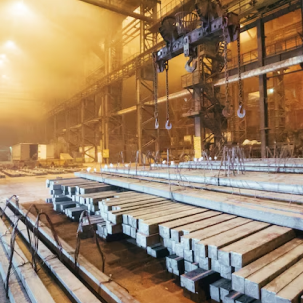
Serbia introduces import quotas on certain steel products
Posted on 15 Jan 2026
Serbia has introduced a six-month quota scheme for imports of certain steel products, according to a government decree that took effect,
Kallanish
notes.
The temporary quota, which came into effect on 1 January, applies to the import of certain ferrous metallurgy products to support market stability in strategic sectors. An additional 50% duty will be imposed on imports in excess of the established quotas, the document says.
Quotas will be distributed among countries and customs territories based on their share of total imports over the past five years. The largest share is reserved for the EU, Turkey, Bosnia and Herzegovina, Albania, and countries in the region.
The government decree covers five commodity groups, including hot rolled and cold rolled steel, ribbed reinforcing steel for concrete, hot rolled wire, and ribbed reinforcing bars. The total quota volume exceeds 420,000 tonnes, with over 250,000t of this being for cement.
The scheme will be implemented in two stages - from 1 January to 31 March and from 1 April to 30 June. Unused quota amounts may be carried over from the first to the second quarter. The customs administration is responsible for implementing and monitoring the scheme, and information on quota utilisation will be reported monthly to Serbia’s Ministry of Domestic and Foreign Trade.
Serbia has passed new laws on greenhouse gas emissions
and carbon-intensive import taxes, which also came into force from 1 January. Both levies will be at a rate of €4/tonne ($4.66/t) of CO2 equivalent.
This is the country’s answer to and equivalent of the European Union’s recently implemented Carbon Border Adjustment Mechanism (CBAM).
Last year, Serbia called for the EU to phase in CBAM gradually to avoid economic shocks (
see Kallanish passim
). The proposal of the Commission to increase tariffs on imported steel will directly impact the Chinese-owned steel plant in the country – HBIS Group Serbia Iron & Steel.
HBIS can produce about 2.2 million tonnes/year of steel with its two furnaces, while No.1 alone has a capacity of about 900,000 t/y. Its product range comprises hot and cold rolled coil, pickled coil and electrolytic tinplate.
Serbia's production of crude steel totalled 1.28 mt in January-November, up by 0.6% on-year, according to worldsteel data.
Source:Kallanish
The South East Asia Iron and Steel Institute (SEAISI) was incorporated in 1971 under the auspices of the United Nations Economic Commission for Asia and the Far East (ECAFE). It is registered as a limited company in the Republic of Singapore. Previously in Singapore and the Manila, the Secretariat is now permanently based in Shah Alam, Malaysia.
SEAISI is a technical institute and its main objective is to promote the iron and steel industry in the South East Asia region. It achieves its objectives by facilitating technology transfer from around the world, especially from Japan, Korea and Taiwan. SEAISI organizes a major international conference and exhibition every year and amongst its publications are the Statistical Year Book and the Monthly ASEAN Iron & Steel Journal.
SEAISI enjoys a large membership base with members coming from all parts of the world, including leading steel companies and material suppliers and equipment suppliers.
Address
No. 2E, 5th Floor, Block 2, Worldwide Business Park, Jalan Tinju 13/50,
40675 Shah Alam, Selangor, Malaysia.
Contact
Tel : +60 3 5519 1102
Fax : +60 3 5519 1159
seaisi@seaisi.org
© 2026 SEAISI SITE. ALL RIGHTS RESERVVED
0
Recent CommentsRelated News You might want to check out
View by
Higher Chinese rod prices gain acceptance in Philippines
SEAISI News
16 January 2026
steel
Rio, BHP explore joint Pilbara iron ore mining
SEAISI News
16 January 2026
steel
Lifecycle partnership – Tata Steel and SMS group produce first coil after extensive CSP® plant upgrade
SEAISI News
16 January 2026
steel
Serbia introduces import quotas on certain steel products
SEAISI News
15 January 2026
steel
Ex-Iran billet trade persists despite sanctions pressure
SEAISI News
15 January 2026
steel
Iraq’s Construction Summit Set for August in Baghdad: Iraq Build Expo 2026 Calendar Revealed
Steel Radar
15 January 2026
steel
Stegra to supply non-prime steel to thyssenkrupp Materials
SEAISI News
15 January 2026
steel
China's steel exports in '25 hit record high of 119 million t
SEAISI News
15 January 2026
steel
How consolidation and tariffs are reshaping the steel supply chain
SEAISI News
15 January 2026
steel
Eti Alüminyum focused on value added production in 2025
Steel Radar
15 January 2026
steel
Export unit value index increased 11.7% compared to last year in November
Steel Radar
14 January 2026
steel
Aegean region records USD 43.7 Billion export volume in 2025
Steel Radar
14 January 2026
steel