RailwayRailway
Hungary Launches A Eur 9.8 Billion Rail Plan
By Railway Pro•07-25-2026July 25, 2026•6 min
Railway Pro•07-25-2026July 25, 2026•6 min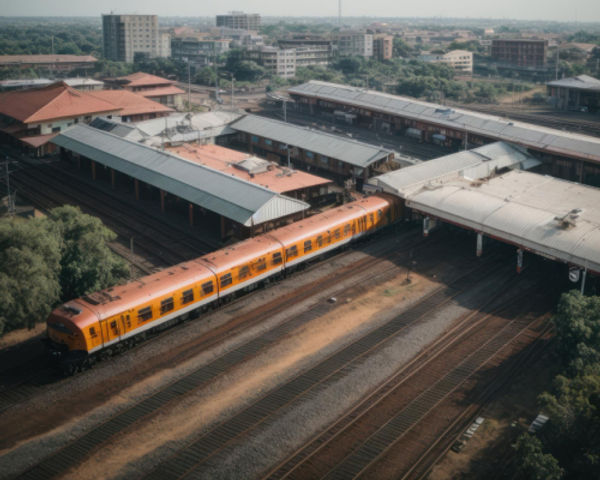 Railway
The Hungarian Government has approved an investment programme worth 3,550 billion forints, equivalent to approximately EUR 9.76 billion, to modernise rail and urban rail transport by 2035. The plan provides for the purchase of at least 35 InterCity trains and 42 HÉV trainsets, the modernisation of lines and stations, the reopening of certain regional routes, and the preparation of high-speed links to Vienna and Warsaw.
The Baross Gábor railway plan for the period 2026–2035 was presented at Rákospalota-Újpest station by the Hungarian Prime Minister, Péter Magyar, and the Minister for Transport and Investment, Dávid Vitézy.
The programme has a total value of 3,550 billion forints, approximately EUR 9.76 billion. The Budapest government describes it as the first Hungarian rail plan designed to extend beyond the duration of a single term of office.
“We are bringing the era of railway destruction to a close and opening a completely new chapter,” said Vitézy, accusing the former administration of halting, postponing or abandoning projects necessary for the modernisation of public transport.
The financial structure presented by the Ministry of Transport and Investment comprises several sources:
Consequently, a significant part of the package depends on future European funds, loans and the mobilisation of private capital, not merely on funds already available in the national budget.
The presentation also includes a stark assessment of the current Hungarian rail system.
The average age of MÁV rolling stock and trains on the HÉV suburban network is 43 years, whilst railcars that do not meet the InterCity standard are, on average, 50 years old.
According to the ministry’s data:
On the MÁV network, 42 per cent of lines are subject to speed restrictions. Of the 50 busiest stations, only 16 are fully accessible, six are partially accessible, and 28 are not adapted for people with reduced mobility.
The government aims to halve the average age of locomotives and railcars over the next ten years.
One of the most important projects is the purchase of at least 35 InterCity EMUs, each with a capacity of between 400 and 500 seats.
The trains will be accessible, air-conditioned and will feature first-class accommodation, a catering area and a level of comfort comparable, according to the ministry, to that found in Western European countries.
The estimated value of the procurement is 450 billion forints, approximately EUR 1.24 billion. The first trains could arrive by 2030.
The new multiple units are set to be introduced on the following routes:
The programme also provides for the introduction of battery-powered trains on major non-electrified main lines, including to improve connections to Baja, Szekszárd and Salgótarján.
The government is also preparing to purchase 42 trains for the HÉV, Budapest’s suburban rail network.
The trains will be 120 m long, with low-floor access, air conditioning, bicycle spaces and fully interconnected carriages. They will be capable of speeds of up to 100 km/h and will be used on lines H5, H6 and H7.
The procurement is valued at 300 billion forints, approximately EUR 824 million, and production could begin by 2030.
Separately, the modernisation of the H5 line to Szentendre is estimated at 174.5 billion forints, approximately EUR 480 million, whilst the first phase of works on the H6 line to Ráckeve and the H7 line to Csepel is valued at 226 billion forints, approximately EUR 621 million.
The projects include the refurbishment of stations, increasing speeds, the development of P+R and B+R car parks, and the installation of new passenger information systems.
The overall aim is to achieve an average speed of at least 100 km/h between stations on the main InterCity routes. To this end, certain sections will need to be upgraded to accommodate maximum speeds of 160 or 200 km/h.
The plan provides for the introduction of an InterCity train every hour, throughout the day, on the most important main lines.
Among the projects listed is the modernisation of the most problematic section of the Budapest–Miskolc line, for which between 200 and 230 billion forints, equivalent to approximately EUR 550–632 million has been earmarked.
The works should enable trains to run at 160 km/h and reduce journey times to Eger, Gyöngyös and Miskolc.
In the west of Budapest, plans are in place to expand the Kelenföld–Budaörs–Törökbálint section to four tracks, to increase the capacity of suburban trains.
The design will also take into account the future entry into the capital of high-speed trains from Vienna and Warsaw. Work could begin by 2030.
Instead of closing secondary lines, the new government promises to reopen routes and purchase modern railcars.
The plan provides for at least five daily services to all towns with more than 500 inhabitants. For smaller towns, on-demand services and bus connections to trains are to be introduced.
Around Budapest, the aim is to have a train every 15 minutes during peak hours. For major regional cities, including Debrecen, Miskolc, Szeged and Győr, the target is a 30-minute frequency.
The suburban line to Veresegyház, Fót and Őrbottyán is set to be fully modernised, increasing the service from one train per hour to four to six trains.
The project is estimated to cost 174 billion forints, approximately EUR 478 million, and could be completed by 2030.
The Ministry will prepare for the complete modernisation of the country’s ten busiest stations. The programme will cover not only the buildings themselves, but also the surrounding squares, underpasses and available railway land.
The government maintains that it will be able to attract private capital, but promises to keep the stations and strategic land in the public interest, rather than selling them off.
The programme also includes plans for a high-speed rail link between central Budapest and Liszt Ferenc International Airport.
Also in the planning stage are the future high-speed lines to Vienna and Warsaw, as well as projects that would allow trains to pass through Budapest more easily, without having to make a final stop at terminus stations.
For freight transport, the authorities aim to eliminate bottlenecks on the main lines, support the construction and use of industrial sidings, and introduce subsidies for transport in individual railcars, with the stated aim of shifting some lorry traffic onto the railways.
Recent Comments
0
Related NewsRailway Related News You Might Want To Check Out
 Railway
Cer Welcomes Stronger Investment Role For Ets Revenues, Calls For Greater Recognition Of Rail'S Carbon Avoidance Benefits
 RAILWAY INTERNATIONAL•Jul 25, 2026•3 minRailway
Hungary Launches A Eur 9.8 Billion Rail Plan
Railway Pro•Jul 25, 2026•6 min Railway
Bulgaria Allocates Funding For Intermodal Transport Operators
Railway Pro•Jul 25, 2026•3 min Railway
Sneak Peek At New Melton Station
 Rail Express•Jul 24, 2026•2 min
 Railway
Germany’S Rail Infrastructure Hits A New Investment Record
Railway Pro•Jul 24, 2026•5 min Railway
Italy Is Allocating A Further Eur 4 Billion To Modernise The Rail Network
Railway Pro•Jul 24, 2026•2 min Railway
Works Begin To Restore Portishead Line For The First...
 Rail Business Daily•Jul 24, 2026•4 min
 Railway
Railway Mission Welcomes Emmanuel Egila As Its New Waterloo-Based Railway Chaplain
Rail Business Daily•Jul 24, 2026•3 min Railway
New Solution For Efficient Wheel-Rail Force Measurements
RAILWAY INTERNATIONAL•Jul 23, 2026•2 min Railway
Turkiye Secures Usd 1.5 Billion For The New Railway Line Across The Bosphorus
Railway Pro•Jul 23, 2026•3 min Railway
Network Rail Consulting Secures $26 Million, Three-Year Asset Management Contract With Sound Transit
Rail Business Daily•Jul 23, 2026•2 min Railway
Speno’S Young Rail Professionals On Fast Track To Success
Rail Express•Jul 23, 2026•7 min Railway
Voestalpine Railway Systems Jez Celebrates Its Centenary As An International Pioneer In Railway Solutions
RAILWAY INTERNATIONAL•Jul 22, 2026•2 min Railway
Mayor Brabin Backs Rail Freight To Sustainably Deliver Local Homes And Jobs
Rail Business Daily•Jul 22, 2026•4 min Railway
Rail Minister Returns To Hither Green One Year After Launch Of Britain’S First In A New Era Of Integrated Railways
Rail Business Daily•Jul 22, 2026•2 min Railway
Delivering Rail’S Digital Transformation
Rail Express•Jul 22, 2026•11 min Railway
Queensland Station To Reopen After Restoration And Upgrade
Rail Express•Jul 22, 2026•3 min Railway
Atlanta Plane Train Workers Ratify Union Contract
 Progressive Rail Roading•Jul 22, 2026•1 min
 Railway
Essential Track Renewals On The Crouch Valley Line
Rail Business Daily•Jul 22, 2026•2 min Railway
North Yorkshire Moors Railway Invests In New Mutual Improvement Classroom To Preserve Railway Skills
Rail Business Daily•Jul 22, 2026•2 min