railwayrailway
Raphaelle Guerineau: Building Australia’S Rail Future
By Rail Express•06-16-2026June 16, 2026•8 min
Rail Express•06-16-2026June 16, 2026•8 min railway
The CEO of Siemens Mobility for Australia and New Zealand shares her thoughts on digitalisation, high-speed rail, and the future of rail in Australia.
Like many people in rail, Raphaelle Guerineau fell into the industry by chance – and never left.
“I’ve been in rail for 20 years, and it’s the perfect industry for me because I thrive on managing complexity,” she said.
“Especially in Australia, we have that added layer of complexity because of the way the government and rail is managed, with different rail standards and governance in the various states.”
Guerineau is a renowned global leader in the rail industry who has been the Chief Executive Officer and Managing Director of Siemens Mobility in Australia and New Zealand since 2019.
Prior to her current role, she held roles as Head of Tendering and Project Execution in Singapore before moving to Australia in 2018 as Head of Products and Operations.
Guerineau is also a board member of the Australasian Railway Association and is a member of the Monash Institute of Railway Technology’s Industry Advisory Board (IAB).
Embracing new technologies
The rail industry is evolving – from advancements in artificial intelligence (AI) to digitalisation. Guerineau said Siemens Mobility is at the forefront of that evolution.
“Siemens has been using AI for 15-plus years,” she explained. “What has changed is that now it’s becoming available to everyone, so we can further maximise the benefits.
“What really helps in the digitalisation sphere is how we can move from a reactive service operation model to a predictive, data-driven one.”
She gave an example of disruptions on a train line.
“With the old technology, if there is a train that is stuck at a station for whatever reason, the trains behind that are stopped too,” she said.
“Now, with our software that integrates AI, we can detect where the bottleneck is and automatically propose a solution to the operator – re-routing the train to another platform, updating the timetable and critically, linking directly to the passenger information system.
“In Sydney, for example, we are implementing our Railigent X solution, which uses AI that helps with predictive maintenance. This means maintenance crews only need to go out on site when there is a need to do so. These things are making rail operations much more efficient and saving operators a lot of time and money.”
A long-term technology partner
Guerineau describes Siemens Mobility as a “technology partner” rather than a traditional rail supplier.
“Digitalisation and AI are unlocking new possibilities for the rail industry, but they also bring some technical challenges that require close, long-term partnerships with the customer,” she said.
“It’s very important to ensure that systems really work together, and that you can plan from the very beginning to the end of an operation, or the end of the lifecycle of the systems in question.”
She said Siemens Mobility always looks at the bigger picture, considering the wider ramifications of actions rather than just carrying out the scope of work within a tender.
“It’s crucial for us to be there at the beginning [of a project], to help influence the specifications,” she explained.
“Productivity is critical. We always ask – how do we make sure we’re getting the best value for money for the taxpayer or our private customers?”
Where global expertise meets local capability
Siemens Mobility is a global leader in transport solutions, with more than 43,000 employees worldwide and has been in Australia for more than 150 years.
Guerineau said the company draws on its local capability and global expertise in Australia and New Zealand.
“We have Centres of Competence around the world, but to keep our solutions cost-effective for our customers, we ensure that we have economies of scale and serve several countries from each Centre of Competence,” she said.
“But when we introduce a new product to Australia, it’s very important that we have the right engineering team here to adapt it to be locally compliant.”
Siemens Mobility combined global expertise with local Australian engineering, signalling, and manufacturing capabilities to develop the new ACM250 axle counter – demonstrating its commitment to leveraging international knowledge while fostering local innovation and setting new benchmarks in rail infrastructure.
“In response to a customer’s challenge, our local product engineering team partnered with our global research and development team to develop and successfully test a new head assembly in an actual grinding exercise without removing axle counter heads, showcasing one of the key advantages of deep local expertise backed by global resources.
“Our manufacturing facilities in Port Melbourne and Perth, as well as our service centre in Mackay, are key sites that allow us to carry out activities close to the customer.”
In addition to developing local capability, Guerineau is deeply committed to promoting gender equality and attracting more women to the rail industry.
“I believe a diverse workforce is essential for the rail sector’s success, and actively encouraging women to pursue careers in this industry is part of that.”
High-speed rail
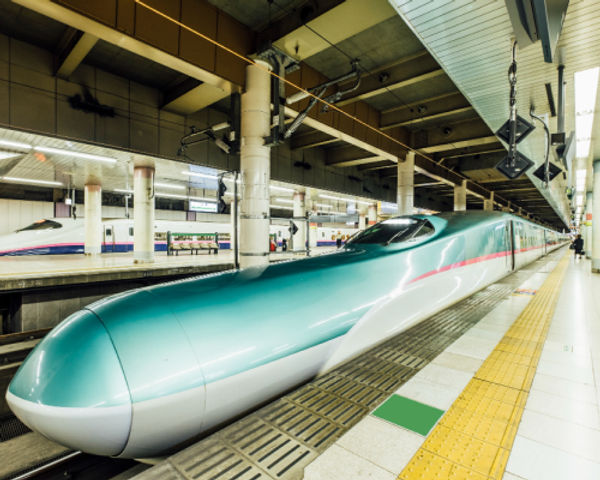
Siemens Mobility has extensive experience in high-speed rail, with over 50 years of experience, with more than 1300 high-speed trains in operation across nine countries.
“These trains are running across multiple countries, much like how in Australia they will eventually be running across multiple states,” said Guerineau. “We have learned so much from these projects – from the topology needed to run high-speed trains, to the power supply requirements and how the signalling systems run.
“The integration of all these systems and early planning is key, so you have certainty of delivery and certainty of costs.
“The implementation of high-speed rail in Australia would revolutionise inter-city travel and offer a sustainable alternative to air and road travel.”
The benefits of innovation
Guerineau said sometimes innovation can be little more than a buzzword.
“It’s easy to talk about things that have never been seen before and how great they are,” she said.
Siemens Mobility’s implementation of the first ETCS L2 digital signalling technology in the freight network in Australia and the North Shore Line in Sydney are examples of how the advanced signalling system has been introduced into Australia. Guerineau said that while the technology is known globally to enhance safety, increase network capacity, and improve operational efficiency, it took dedication and expertise to make this a reality in Australia.
“We want to focus on the actual benefits of the technology for the end user. Will it lead to a longer life cycle, higher asset availability, and cost savings?
“It’s not about innovation for innovation’s sake.”
Interoperable networks
Guerineau said she is pleased to see the progress that has been made in moving towards signalling interoperability in Australia, with transport ministers deciding in 2025 to designate the ETCS (European Train Control System) as the signalling standard for the future, as part of the National Rail Action Plan (NRAP) for a modern and interoperable rail network in Australia.
“The National Transport Commission (NTC) has been working hard over the past few years to move this forward,” she said. “The Australian Rail Industry Standards Board (ARISO) is also looking at the next level of implementation and of mandatory and voluntary standards.”
In addition, these organisations are looking at the harmonisation of competencies, because there are different rules and requirements in each state. This makes it hard for skilled people within the rail industry to move between projects in different states.
“This is really a shame, from a technology perspective, because it blocks access to a very competent workforce,” Guerineau added.
“The work that the NTC, ARISO and ONRSR are doing is essential, and we are big supporters.”
Looking to the future
In the future, Guerineau looks forward to more sustainable rail networks.
“I think digitalisation and decarbonisation will become even more important in the future,” she said. “At Siemens Mobility, we are currently the only company integrating data and artificial intelligence across the entire mobility ecosystem. As urbanisation and global transportation demand accelerates and sustainability pressure rises, we recognise that operators must deliver more capacity, higher reliability, and better passenger experiences, all whilst optimising their lifecycle costs. Data and AI are the key enablers.”
She also thinks uptake of AI-enabled technology will continue to increase, bringing with it more connected railways and streamlined maintenance.
“We will have all the different systems talking to each other in one platform – from the track to the trains to the signalling to the power supply,” Guerineau continued.
“Technology and cities alike grow fast. And we’re ready to set the pace, because now is the moment for us to transform the future of rail – together.”
Recent Comments
0
Loading related news…